
Table of Contents
You're probably reading this with a flashlight in your hand, looking at a spot of moisture at the bottom of a wall or a puddle that wasn't there yesterday. The real question is not whether it's stressful, you already know that. It's knowing where the water is coming from, if your home is in danger, and what to do next.
This article answers all three of these questions. He explains why a basement water problem occurs in Laval, how to recognize the source of the infiltration yourself, and what solutions exist, from the simplest that you can fix on your own to drainage work that requires a contractor.
Why Laval homes are particularly affected
Laval is not a field like any other. Several areas are based on clay soils that retain water strongly instead of allowing it to percolate. In neighbourhoods such as Chomedey, Vimont, Duvernay or Sainte-Rose, it is not uncommon to see infiltration appear after heavy summer rains or snowmelt in the spring.
Clay swells when it absorbs water and shrinks as it dries. This perpetual motion, combined with Quebec's intense freeze-thaw cycles, makes the foundations work and cracks the concrete year after year. When the land is poorly leveled or the French drain is aging, water accumulates around the foundation and exerts significant pressure on the basement walls.
This is why a water problem in Laval can rarely be solved with an improvised solution. You have to understand the soil before you understand the water.
Why Water Enters Your Basement
Water does not magically pass through concrete. She always benefits from a path that your land or your house offers her. Understanding this path is half of the solution.
Three factors come up constantly. First, hydrostatic pressure, i.e. the water accumulated in the ground around the foundation that ends up pushing through the slightest crack. Secondly, the poorly directed surface runoff, when the land slopes towards the house rather than the opposite. Finally, a foundation drain, the famous French drain, which is clogged, crushed or simply too old to do its job.
In the field, most of the infiltrations we see in Laval do not come from a serious structural crack. They come from inadequate surface drainage or a French drain at the end of its life, two situations that are much less worrisome than they seem.
Expert tip: If your basement takes on water in the spring or after a thunderstorm, but stays dry the rest of the year, the culprit is almost always the exterior drainage, not the concrete itself.
How to identify the source of the problem in your home
Before calling anyone, you can make an initial diagnosis. Where the water appears says a lot about where it came from.
Water at the bottom of the walls or at the junction between the wall and the floor usually points to hydrostatic pressure or a failing French drain. Water following a visible crack in the concrete wall indicates point infiltration, which can often be repaired. Water near a basement window or skylight indicates a surface drainage problem around the opening.
Also look at your land. Does the floor slope down towards the house or away from it? Are your gutters pouring water directly against the foundation? Compacted soil along the wall, which forms a basin, directs the water exactly where you don't want it.
Have your water problem analyzed for free
What you can fix yourself, and what a pro takes
Let's be honest: not every water problem needs a contractor. Before starting any work, here is what is within your reach.
If your gutters overflow or spill water at the foot of the wall, extending the downspouts to move the water a metre or two away from the foundation can sometimes solve the problem on its own. If a flower bed or soil has settled against the wall to form a basin, bringing back a little soil to restore a slope that is moving away from the house may be enough. And a thin, isolated hairline crack, without active water inflow, is often monitored before repairing itself.
On the other hand, as soon as there is a recurrent influx of water, a crack that allows water to pass through, or surface corrections do not change anything, the problem is deeper. This is where a drainage analysis and, sometimes, excavation becomes necessary. Better a correct diagnosis than a cosmetic repair that comes back next spring.
Request an analysis of your land
Drainage solutions according to gravity
For situations that go beyond the homemade fixes, here are the solutions classified from mild to serious problem.
Correct surface drainage and leveling
This is the first thing to check, and often the least expensive. Reprofiling the land so that it is away from the house, extending the downspouts and correcting an inverted slope solves a large part of the water problems, especially when infiltration appears only after heavy rains. Our grading and earthmoving service tackles this cause directly.
Installing or replacing a French drain
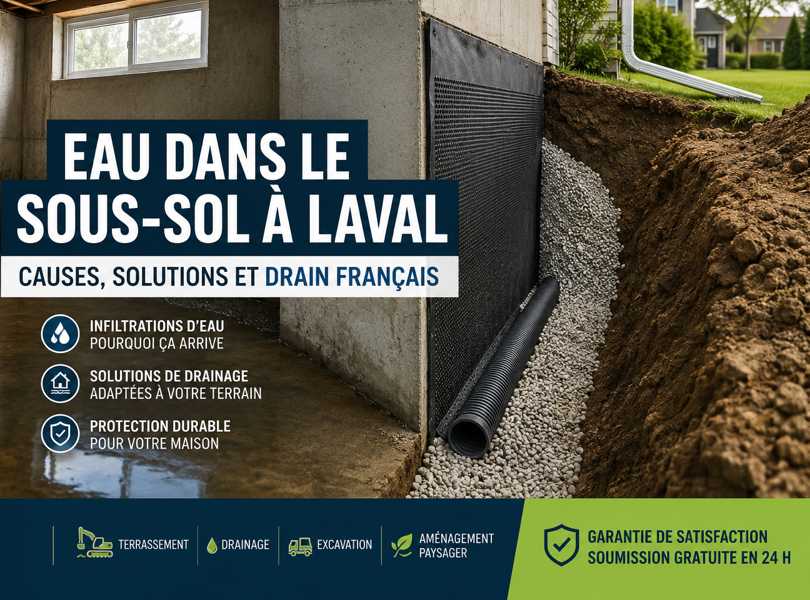
The French drain is a perforated pipe installed at the foot of your foundation, underground, which captures water from the ground and evacuates it away from the house. When it is clogged with soil, crushed by roots or at the end of its life, the water no longer has an outlet and rises. Replacing it requires excavation around the foundation, the installation of a new drain, a geotextile membrane and a clean stone bed that prevents clogging. It's a serious project, but it's the sustainable solution when the original drain is in question.
Combining multiple approaches
In many cases, the strongest solution combines ground leveling, a new French drain and sometimes the repair of a targeted crack. An analysis of the topography of your property allows you to target exactly what your home needs, without paying for unnecessary work.
Did you know: a well-installed French drain, with a geotextile membrane and compacted aggregates according to standards, is designed to last for decades in the Quebec climate. Coupled with proper leveling prevents the problem from coming back.
And after the work, your land
An excavation around the foundations inevitably leaves traces on the lawn and the landscaping. The good news is that we are not just plugging the hole. Since we also do the installation of peat, the paving stones and the complete landscaping, we restore your yard, and often better than before, once the drainage is fixed. One team, one contract, from diagnosis to the last clod of grass.
Why entrust your drainage to Aménagement DDL
Fixing a water problem in the basement is no ordinary landscaper's job. This requires strong expertise in drainage, excavation and surface water management, because you have to excavate, understand the flow of water and restore the land once the work is done.
Aménagement DDL carries out earthworks, excavation and drainage projects in Laval, the North Shore and the Laurentians. As a member of the Réseau des professionnels de l'habitation du Québec, our team is insured and works according to the standards of the construction industry. Each project is covered by our satisfaction guarantee: if the result delivered does not correspond to what is written in your quote, we will come back to correct it at no additional cost.
Ignoring an infiltration does not make it go away. Water continues to weaken concrete season after season, and an early intervention almost always costs less than a foundation to be rebuilt later.
See our earthmoving and drainage service
Frequently asked questions about water in the basement in Laval
Pourquoi mon sous-sol prend-il l'eau après une forte pluie ?
Quels sont les signes d'un drain français bouché ?
Combien de temps dure un drain français ?
Une fissure de fondation provoque-t-elle toujours une infiltration ?
Combien coûtent des travaux de drainage à Laval ?
Faut-il un permis pour des travaux de drainage à Laval ?
Don't let water damage your foundation anymore
Every season that water collects around your foundation increases the risk of damage to concrete, your basement finishes, and ultimately, the value of your property. An ignored drainage problem does not stabilize: it worsens with the rate of rains and thaws.
An inspection can often quickly identify the real cause and avoid much more expensive repairs later. Our team travels to Laval, the North Shore and the Laurentians to analyze your land and offer you the solution that really suits your home, with a response within 24 hours.